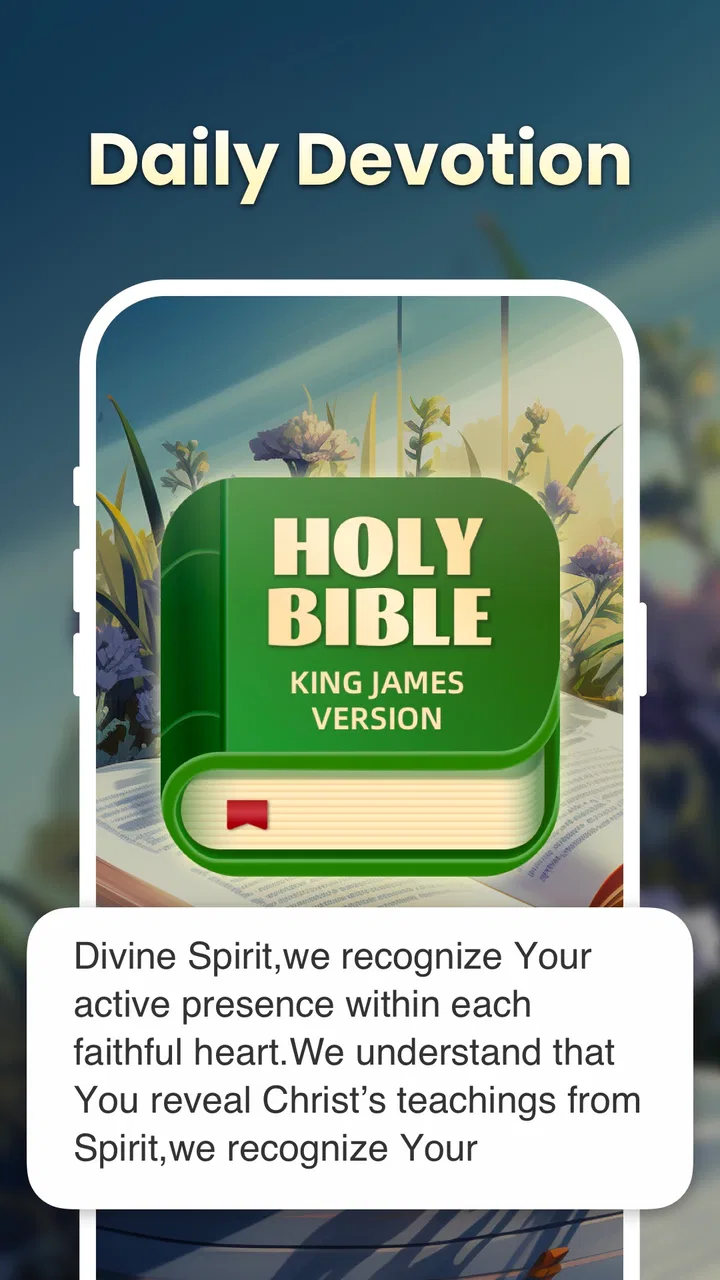
Holy Bible - KJV+Audio+Verse
- 4.4
- Rating
- 1.00M
- Installs
- Free
- Price

 Analysis by App-foxy
I usually judge a Bible app by what happens after the first few days. Opening a verse in a quiet moment is easy; returning to it when the novelty has gone is the real test. Holy Bible - KJV+Audio+Verse makes a strong first impression because it brings together the King James Version, verse-focused reading, and audio in one free Books & Reference app. I found it most appealing when I wanted a simple way to read or listen without treating Bible study as a complicated project.
The app comes from LiveLauncher and is available to a broad audience with an Everyone age rating. It has reached over one million installs and holds a 4.4 average from around six thousand ratings, which suggests that its straightforward approach works for many readers. Still, popularity alone does not make an app a lasting part of a daily routine. My experience is that its long-term value depends on whether you appreciate the KJV wording, can tolerate a relatively focused feature set, and build a habit around it rather than using it only when curiosity strikes.
What makes the first week appealing
The first thing I noticed is how clearly the app is aimed at reading and prayer. Instead of asking me to learn a complicated study system, it puts the Bible itself at the center. That matters for someone who wants to open a passage quickly before work, read a chapter in the evening, or listen while taking a quiet walk. The combination of written verses and audio gives the same material two different entry points, which is more useful than it may sound.
You May Also Like

 Blood Strike: 2.5 Anniversary
Blood Strike’s Loadouts Turn Every Drop Into a Tactical Gamble
A close look at Blood Strike’s custom loadouts: how fast access to signature weapons reshapes its battle royale rhythm, rewards preparation, and narrows the gap between fights.

 Pandora - Music & Podcasts
Pandora’s Music Is Easy to Start, but Harder to Recover
Pandora’s strength is its low-effort path from a seed to a station. Its weak spot is how much confidence it asks you to place in connection, setup, and quiet recovery.

 8 Ball Pool
 Is Built on Rivalries, Rematches, and Routine
A close look at the rivalries, rematches, shared routines, and unanswered safety questions that turn a quick pool match into a persistent mobile community.

 Samsung Music
’s Quiet Strength Is Playing What You Already Own
Its reach comes less from spectacle than from dependable access to a personal library. That simplicity is both the app’s strongest retention engine and its ceiling.

 AccuWeather: Weather Radar
AccuWeather Review: A Quick, Clear Forecast for Everyday Decisions
For everyday plans, the best forecast is the one you can understand quickly. AccuWeather makes rain timing, radar, and local conditions easy to act on, with a few trade-offs.

 Hill Climb Racing
Why Hill Climb Racing Still Turns Crashes Into One More Run
A tiny car, a bumpy hill and one more upgrade: Hill Climb Racing keeps resurfacing because its simple chaos makes every near-miss feel personal.
More From Our News Desk



Reading works best when I want to slow down and notice the language. The King James Version has a distinctive rhythm and vocabulary, so it can feel especially meaningful to readers who already know it from church, family reading, or personal study. It is not the easiest translation for everyone, though. New readers may find older expressions less immediate, and that can make a short reading session feel like interpretation as well as devotion. If plain contemporary English is your priority, another Bible app with a modern translation may be a better first choice.
Audio changes the experience in a practical way. I can listen when looking at a screen would be inconvenient, such as during a calm household task or while preparing for bed. It also helps me stay with a passage when my attention is tired. I would not use it as a replacement for careful reading, because listening can make familiar lines pass by too quickly, but it is a useful second mode rather than a decorative extra.
A realistic first-week routine would be to choose a short section in the morning, read it once, and listen to the same section later. That simple repeat reveals something the store summary does not: text and audio serve different kinds of attention. Reading lets me pause over an unfamiliar phrase, while audio gives the passage a steady flow. Using both on the same day makes the app feel more like a small daily tool than a book that happens to be stored on a phone.
The verse emphasis is also convenient for brief moments. If I have only a few minutes, I do not need to commit to a long study session. I can focus on one verse, read around it for context, and return to the wording later. My advice is not to treat a verse in isolation automatically. The most useful habit is to read the surrounding passage first, then use the verse as a point for reflection. That keeps the app from turning Bible reading into a collection of disconnected quotations.
Because it is free, the barrier to trying it is low. I can install it without making the decision feel permanent, and that makes it suitable for someone exploring a digital Bible for the first time. The current version is 1.5.0, and the app supports devices running Android 7.0 or later. That broad compatibility is helpful for people using an older phone, although the actual comfort of reading will still depend on screen size, audio quality, and how well the device handles background listening.
Who benefits most from the combination of text and audio
I would recommend it first to readers who already want the KJV and prefer a focused Bible experience over a large religious content platform. It also suits people who alternate between visual and audio reading. Someone with a regular prayer routine may appreciate having the same app ready for a short passage, while a family member who is less comfortable reading on a small screen may prefer listening.
It is less convincing for users who want extensive academic tools, several translations side by side, elaborate study notes, or a broad library of devotional material. Those readers may be happier with a more comprehensive Bible platform, even if that means a busier interface. This app’s appeal comes from keeping the central activity recognizable: open the Bible, read a verse or passage, and listen when that is more convenient.
What remains useful after the first month
The month-to-month question is whether the app can support repetition without becoming dull. In my view, it can, but not because it constantly supplies new content. The Bible itself provides the depth; the app provides a convenient doorway. That distinction is important. If I expect a stream of fresh explanations, challenges, or personalized programs, the experience may feel limited. If I want a dependable place for recurring reading and prayer, its restraint becomes a strength.
I found the most sustainable use in attaching the app to an existing moment rather than waiting for free time. For example, I might read a passage after making coffee, listen during an evening walk, or use one verse as the starting point for a short prayer before sleep. The specific moment matters less than its consistency. A Bible app earns lasting space when opening it becomes as natural as reaching for a calendar, not when it depends on a burst of motivation.
One useful workflow is to separate discovery from reflection. During a spare moment, I can listen to a passage without demanding that I understand every line immediately. Later, I can return to the written text and consider one phrase more carefully. This prevents audio from becoming background noise and prevents reading from feeling like a task that must be completed in one sitting. It is a small change, but it makes the two formats work together instead of competing.
Another practical approach is to keep sessions deliberately modest. A long reading plan can sound admirable and still collapse when a busy week arrives. With this app, I would rather choose a manageable passage and return regularly than create a demanding schedule that turns missed days into guilt. The verse-centered design works well for that approach because a short session still feels complete, while the audio option gives me a way to continue on days when reading is inconvenient.
The KJV also gives the app a particular long-term character. Familiar passages can gain meaning through repeated reading because the phrasing becomes recognizable. At the same time, the older language can create friction when I encounter a passage I do not know well. I would keep a separate translation or reference source nearby if precise comprehension matters for study. That is not a criticism of the KJV itself; it is a reminder that literary familiarity and immediate clarity are different needs.
For prayer, I found that the app works best as a prompt rather than a complete spiritual system. A verse can begin a prayer, provide a theme for reflection, or help create a quiet transition between parts of the day. The app does not need to tell me what to feel for it to be useful. In fact, its limited scope can leave more room for personal interpretation. Readers who prefer guided devotionals may find that space empty, while readers who want the text to lead may appreciate it.
The app’s audience size and 4.4 average indicate that it has found a stable place for many people, but I would not use those numbers as a substitute for personal fit. A reader who dislikes the KJV will not become comfortable with it simply because the app is well liked. Conversely, someone who values that translation and wants audio may find more recurring value here than in a feature-heavy alternative that feels distracting.
How much maintenance the habit requires
Maintenance is one of the quiet advantages of a focused Bible app. There is no need to organize a large personal library or learn a complicated workflow before reading. My ongoing responsibility is mainly behavioral: remember to open it, choose a sensible passage, and give the session enough attention to be more than a quick tap. That low setup burden makes it easier to keep using than apps that demand extensive customization before they become useful.
At the same time, a simple app can place more responsibility on the user. If I want a structured long-term study, I may need to create my own sequence and remember where I stopped. If I want detailed cross-references, historical background, or translation comparison, I may need another resource. The app is easier to maintain precisely because it does less, but that also means I have to supply the structure when my goals become more advanced.
Audio listening needs a little discipline too. It is tempting to press play while doing something else and later assume that the session was meaningful simply because the words were present. I get more from it when I decide in advance whether I am listening for comfort, familiarity, or close attention. For close study, I would choose text. For maintaining contact with a passage during a busy day, audio is the better fit.
Device age is another practical consideration. Android 7.0 support makes the app accessible to many older phones, which is useful if I do not want Bible reading to require a recent device. On a smaller or slower phone, however, reading comfort may not match the experience of a newer handset. I would test the text size, audio controls, and general responsiveness during the first few sessions rather than assuming that compatibility guarantees a perfect fit.
Since the app is free, it is easy to keep installed without financial pressure. That is helpful for a tool I may use intermittently, but it also makes it easy to leave unused among other apps. I recommend placing it somewhere visible if the goal is a daily habit. A hidden app rarely becomes part of a routine, no matter how useful its content is.
Where fatigue can appear
The main source of fatigue is repetition without a personal plan. Opening the app, reading a random verse, and closing it can feel satisfying for a few days but may not develop into a meaningful practice. I would avoid judging the app by that shallow pattern. Instead, I would decide whether I am reading sequentially, revisiting a favorite book, or listening to a short section each evening. A clear purpose makes the focused design feel intentional rather than bare.
The KJV wording can create a second kind of fatigue. Its cadence may be beautiful, but unfamiliar terms can slow comprehension. If I am already tired, I may lose the thread of a passage and need to reread it. That is a genuine trade-off: the translation can offer a traditional voice, yet it may ask more effort from readers who are not accustomed to it. For a first-time Bible reader seeking the quickest understanding, a modern-language app is likely the kinder option.
Audio can become tiring when used passively for too long. Without the visual anchor of the page, it is easier to miss a transition, lose concentration, or remember only a general mood. I would use shorter listening sessions and return to the text when a passage raises a question. That workflow gives the audio a clear job and reduces the feeling that the app is merely playing in the background.
There is also a limit to how far the app can serve specialist needs. Someone preparing a lesson, comparing translations, examining original-language details, or researching historical context will probably outgrow it. A larger study platform or dedicated reference tools would be more appropriate in those situations. I would not consider that a failure; it simply defines the app as a reading-and-prayer companion rather than a complete research environment.
Does it deserve lasting space?
After the novelty fades, I think this app earns a place on the phone for a specific kind of user: someone who wants the KJV in a direct, accessible format and values having audio available when reading is not practical. Its lasting value comes from repeatability. I can return to the same text in different ways, fit a short passage into an ordinary day, and avoid the maintenance burden of a complicated study system.
I would skip it if I need multiple translations, deep commentary, extensive organization, or a guided devotional program. I would also hesitate if the KJV’s older language regularly interrupts understanding. In those cases, a more expansive Bible app or a modern translation may serve the purpose better. Choosing a different tool is not a rejection of this one; it is recognizing that convenience and depth are not always found in the same place.
For my own use, the best long-term pattern is simple: read a passage when I can give it attention, listen when circumstances make that easier, and return to context before treating a single verse as a complete message. That approach makes the app more durable than a novelty download. Its real strength is not constant stimulation, but dependable access to a familiar translation whenever a reading or prayer habit needs a quiet, low-friction starting point.
LiveLauncher has kept the focus on the Bible rather than surrounding it with unnecessary complexity. The free price and Everyone rating make it approachable, while support for Android 7.0 or later helps it remain practical on older devices. My final recommendation is positive but specific: install it if the KJV, audio listening, and straightforward verse reading match the way you already want to engage with Scripture. If they do, Holy Bible - KJV+Audio+Verse can remain useful well beyond the first week; if they do not, its simplicity will feel more like a limitation than a benefit.
FAQs for Holy Bible - KJV+Audio+Verse
01Is the Holy Bible - KJV+Audio+Verse app free to use?
Yes, the Holy Bible - KJV+Audio+Verse app is free to download and use. However, it may offer in-app purchases or premium features that require payment. These might include ad-free experiences, additional translations, or enhanced audio features. Be sure to check the app store for specific details regarding any costs.
02Does the app require an internet connection to function?
The Holy Bible - KJV+Audio+Verse app can function offline for reading the Bible text. However, features like audio playback, daily devotionals, or video content may require an internet connection. It's advisable to download necessary content when connected to Wi-Fi to ensure full functionality when offline.
03What features does the app offer besides reading the Bible?
Besides reading the King James Version of the Bible, the app includes audio playback for listening to scriptures, daily devotionals, verse sharing, and possibly study tools like commentaries or cross-references. These features enhance the user’s spiritual study and engagement with the text.
04Can I customize my reading experience on the app?
Yes, the app typically allows for customization of the reading experience. Users can adjust font size, switch between day and night modes, and bookmark or highlight verses. These options are designed to enhance readability and allow for a personalized user experience.
05Is the app suitable for children and family use?
The Holy Bible - KJV+Audio+Verse app is generally suitable for all ages, including children. It provides a family-friendly interface with content appropriate for younger users. Parents can use the app to engage children in Bible study and listen to audio versions together, making it a versatile tool for family worship.
Pros
- Includes offline access for convenience.
- Audio feature enhances engagement.
- Intuitive navigation for easy use.
- Daily verse notifications inspire users.
- Bookmarking for quick reference.
Cons
- Contains occasional ads that interrupt.
- Audio requires internet for streaming.
- Limited translation options available.
- No customization for text size.
- Basic search feature lacks filters.

Holy Bible - KJV+Audio+Verse
Gallery